I must confess I lament my education. How is it possible for me to have majored in Spanish Literature and still remain almost clueless about the history of this region? Sure, I read all kinds of books. And, conceptually, I understood the words poverty, war, guerrilla warfare, campesinos...but I did not understand at all.
We watched a movie called ‘Voces Inocentes’ last Thursday for the daily activity with my Spanish language school. It told the story of an 11 year old boy and what his life was like during the war in El Salvador. The intense imagery of this movie is hard to describe. If any of you have seen Hotel Rwanda, it’s like that. But worse. How can it be that I know more about boy soldiers in Africa and had no idea that during the 70s and 80s in this region, boys as young as 9 years old were called out of school and marched to join the government soldiers. The ‘insurgents’ would warn the village of a raid for boy soldiers by telling the kids, who would write notes themselves and distribute them to the houses. The day of the raid, the boys spent the day on the roofs of the houses hiding. During the night, they hid under their beds while bullets came flying through the house because their walls are only made of zinc. People died it their houses from being hit by crossfire. We have school shootings, but the soldiers used the elementary school as a battlefield; while the kids were in class. Thousands ran, thousands of refugees, widows, and orphans. And they showed us this movie because it tells a common story of what happened in Guatemala. And Nicaragua. And in parts of Honduras. And all over the world, every day, now.
Where was this movie during my supposed higher education? Even in my spanish cinema class we watched artistic, abstract love stories. Great, so I learned how to write essays comparing characters and themes; I`m a pro at literary criticism and dissecting the structure of a book. And I know next to nothing about this world. How it works. How people live. Their history that defines them. Nothing.
Guatemala had a 36 year long ‘internal conflict’ with the peace accords being signed just 12 years ago. That means that while I was afraid of scary clowns or that there was a giant venus fly trap monster hiding under my bed, other kids were hiding under their beds to stay alive. I asked my spanish teacher what it was like for him to live in Xela during the war. There was not as much violence and fighting in Xela as there was in more rural parts of the country, but they still came and took boys away to fight. He described to me that the soldiers’ vehicles had a unique sound, so anytime one of them heard it, they ran. And ran. Knocking on doors for anyone who would let them in until the soldiers passed. ‘I remember my father telling me: don’t talk to anyone you don’t know, don’t touch anything that isn’t yours. Because there were spies everywhere and they knew that children would always tell the truth. They put objects that look like soccer balls on the ground so curious children will play with it. One day, a young boy picked one up to play with it, and died from the explosion in his hands. They did this to try to convince everyone it was the guerillas that did it so people would turn against them.’
Ask me to talk about the themes of Jorges Borges` Ficciones, and I can rattle of all kinds of interesting abstract ideas. Ask me who was the leader when, what the campesinos were fighting for, exactly how Che Guevara organized counterinsurgents, and where the truth lies between Che as a terrorist and Che as one of the most influential revolutionaries for human rights, I can’t tell you hardly anything.
There are immigrants from this region in the United States that are there because they were escaping war and poverty. Kids in my generation that know fear unlike any I have ever, and probably will ever, experience. I want to know: what’s the point of reading a book if you don’t have the context to go with it? How far does being able to write literary comparisons get you? People pay thousands of dollars to get a piece of paper saying they’re educated. I went to college because it’s just what you do, more or less expected, like brushing your teeth every day. Many people here go to college because it’s their way out of a cycle. Another story my spanish teacher told me was that when he went to teach kids in a rural village, he told them to study hard and they can go to college. Most of them laughed, as if he told them they would turn into unicorns. No one ever told them it was possible to go to school past the 6th grade, that they could be anything they wanted to be. Because the majority of the time, they can’t. The boy in the movie wanted so badly to be a bus driver, so he could drive to ‘far away’ places he had never seen. Compare a bus driver to an astronaut, a doctor, an entertainer.
If only I could go back and tell myself to take more advantage of my years at school. You can spend your whole life reading and writing theory, but in my opinion, there is no better education that sitting face to face with someone who’s lived it. There are no words for war or poverty. Even now, writing them, seems inadequate.
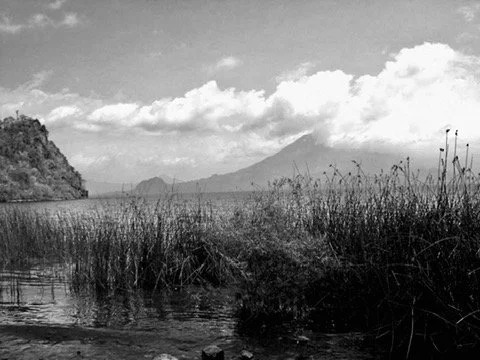
Sometimes I wish I could turn it off, and retreat into a complacent bubble, without even knowing I’m doing it. I went to Lake Atitlan last weekend, noted by many as one of the most beautiful places in the world. I’d have to agree. The lake is huge, with three volcanoes surrounding it, and a number of different villages that you can get to by boat across the lake. From one side to the other takes about 40 minutes by boat. The two villages I spent time in had somewhat of a laid back Caribbean feel, and was gringo central. When you descend into the valley that is Lake Atitlan, you descend into a bohemian oasis, dreadlocks, piercings, tattoos abound. I have a certain level of identification with this kind of lifestyle/perspective, but driving by the shacks in the upper hills was not lost on me. The intensity of the movie I just saw was (and is still) with me. There was a ‘festival of consciousness’ going on while I was there with such topics as environmental awareness, meditation, yoga, and, well, consciousness. Ha, the irony. What does consciousness mean anyway? Conscious of what? I’m not discrediting the workshops, but it made me wonder what level of consciousness there was of the history of the very hills and villages such ‘festivals’ take place in that were occupied by government soldiers just within the last decade. Not exactly the friendliest conversation starter: ‘oh, so you’re here for the festival? you’re from Canada? that’s cool. so how do you think your lifestyle, upbringing, ideology, and yoga practice fit in to the overall history of the world and its insurmountable suffering?` I don’t know. I didn’t try asking. Maybe I’d be surprised.
I think I could keep going on this for awhile. And I suppose I will as I continue to travel and absorb the history through my experiences. Hopefully somewhere along the way I’ll also find out just what it is you do with a B.A. in Spanish Literature and find my purpose.
march 2009
