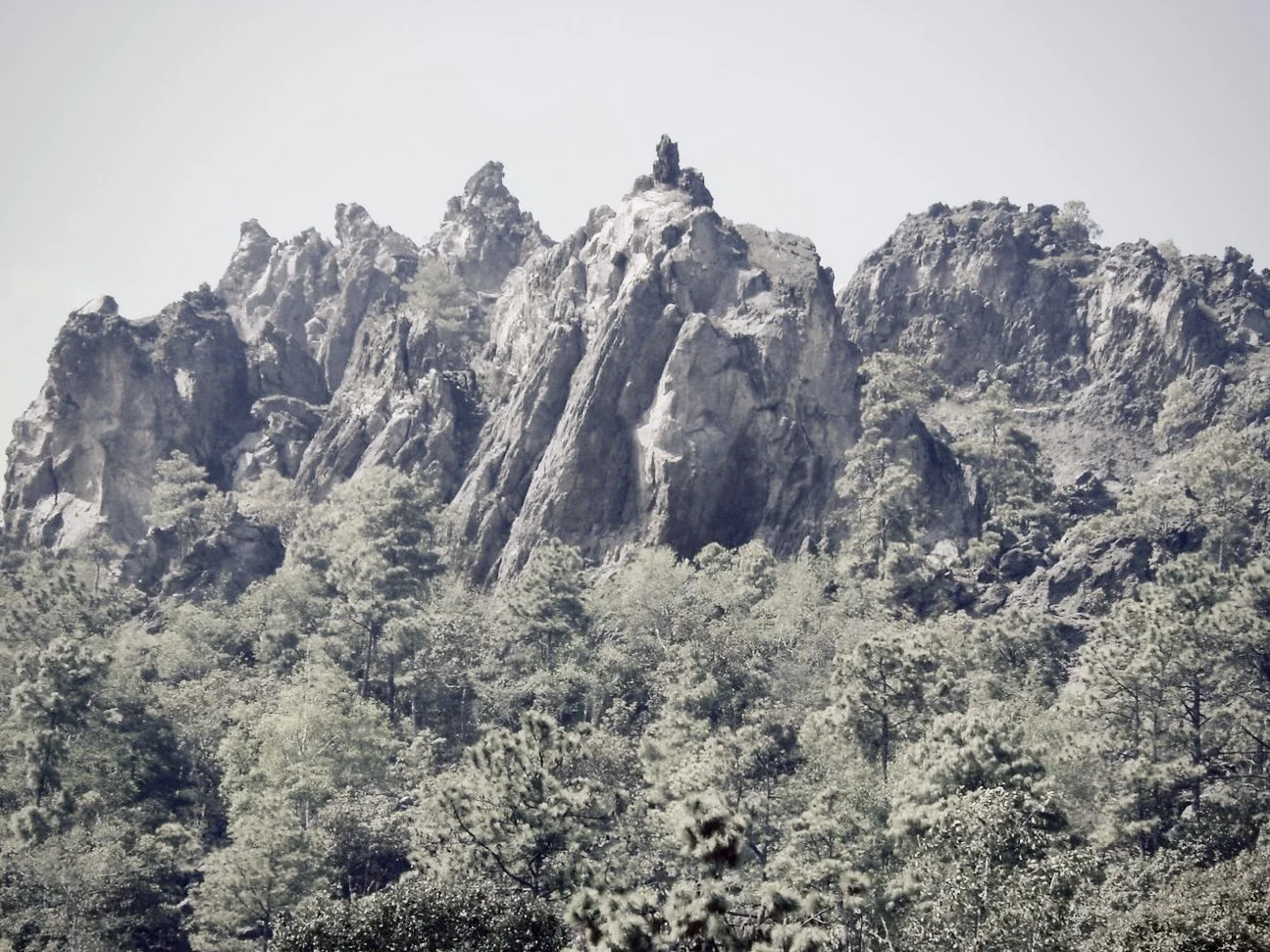
So, in just a few days I will be in Belize City. I have to say, I’m actually ready to move on and see a new place. Especially one that is much warmer and less windy than Xela, where it still gets down into the 40s at night. A little beach action could be nice too. Though I’m sure I will learn and see a lot about the country through my volunteer work there.
I want to write a bit of a tribute to my Spanish teacher in this particular entry. I realize my last entry was a bit on the philosophical side, but to write about the field trips I made to this that and the other place seems a little inadequate compared to the story I heard from my Spanish teacher yesterday.
For one of our field trips, Eduardo wanted to take me to a place called ´La Muela´ which is about a two hour hike from Xela, to an area of volcanic rock that has an amazing view of Xela. During our hike up, Eduardo told me his story of being in the US as an undocumented worker. As we climbed up to get to the top of La Muela, me breathing hard since I haven't hiked in a while, he told me the story of his journey crossing the border into Texas, swimming across a river, walking 28 hours straight without food, freezing temperatures as night, and boiling temperatures during the day.
The story began with him telling me how after studying for 3 years at the university, they told him he missed a class, and for whatever bureaucratic reason, had to redo all his classes, all three years, to make up for it. Needless to say, it was a difficult thing to accept, to have to redo everything you'd already worked so hard to do. It upturned his reality, and he fell into depression. It’s difficult to describe and translate everything, but the short of it is, he decided to go to the U.S. to change his situation. So he went with a friend and paid a coyote ($2,000 US dollars. Can you imagine?) to help them get across the border from Mexico. They walked for hours the first day, having to walk through swamps, get muddy and wet, while trudging their way through the hills/mountains. Then they reach the Rio Grande, taking off their clothes to swim across, a ritual that is believed to give you a ´clean´ and safe entry into the U.S. (Later, when Eduardo gave me the book he started writing recounting his experience, the narration includes at this point: “Now I know why they call us wetbacks (mojados).” )
At night, they walk, avoiding the bright lights from the border patrol, sleeping on the ground, unable to move to avoid making a sound, freezing, wet, and terrified they'll be found. They encountered rattlesnakes, coyotes, bulls, spiders, and rats. They encountered human bones, from people who didn't make it. Sometimes a group of bones in one place, maybe an entire family trying to make it across. Their ‘guide’, who makes this trip 3 times a week, takes drugs, sniffs cocaine, to keep up the energy to guide them through. As Eduardo and I climb to La Muela, a not horrible but not exactly easy hike, he tells me, “I used to run from Xela up to the top of this almost every day, and that journey across the border almost killed me; I don't know how other people do it.”
He then told me about his experience working in the U.S. for four and a half years, cleaning bathrooms, painting houses, doing construction, and landscaping. He told me people tell their families that they have a job in an office to avoid the embarrassment of telling the truth that they work in a restaurant taking out the trash. As Eduardo is the kind of person to always be honest, he told his friends and family the truth. And they said, you? How is this possible? You studied for three years at the university, you know how to do algebra, calculus, you were studying to be a lawyer! And as Eduardo says, ‘solamente cosas de la vida’ (just the things of life).
Eventually, his brother figured out how to get around the problem at the university and they decided they would let Eduardo return and pick up at school where he left off. As soon as he found out, he came back to Xela to continue studying so he can become a lawyer. He told me he realized how much he had in Xela, how much he wants to do something for his country and be able to help people. Some people think he’s crazy for leaving the U.S. and all of the ‘opportunities’ there. To return to a life where you’re valued and esteemed for being educated, instead of working from 5am to 6pm to paint huge hotels and mansions for $8/hour, is something I can understand.
Today during class, Eduardo showed me his memoir of the experience, some 58 pages long so far, hand written in a notebook. He had me read it aloud for the practice, but I couldn't finish reading without choking out the words. (Sound familiar, Mom?) I asked him to keep reading for me. I asked him, how is it that you can tell this story without getting emotional? And he told me, “because to become too sad about the experiences you have can become an obstacle to moving forward, so I’ve become very good at being able to control my emotions.” My god, if I could reach that ability sometime in my life, it would be a miracle. I’m crying like a baby at intense movies and reading his memoir, let alone experiencing it first hand.
I’m writing this because I want you to know the kind of person I’ve spent the last four weeks with. A rare, amazing person that I truly admire. A person who has a saying written on his folder that says: ´La vida es un dibujo, sin borrador´ Life is a drawing, without an eraser.
It’s impossible for me to do justice to his story here, many details and context are left out. But his story is only one of many. Many people aren't so lucky. Many people didn't/don't have the education he had to maybe be treated with a little more respect. Many people don't have the strength of spirit to be treated like a dog for 11 hours a day, and then go to English class for 3 more hours, or even if they did, have the money to pay for lessons.
There is a song that Eduardo shared with me today, too (one in a string of many over the last few weeks) called ´Mojado´ (Wetback) about the undocumented immigrant experience. The last verse is: ´Si la visa universal se extiende el dia que nacemos y caduca en la muerte, porque te persiguen mojado se el consul de los suelos y te dio permiso´ If the universal visa extends from the day we are born til the day we die, why do they persecute you, wetback, when the console in the heavens already gave you passage.
Have you even had so much conviction for something in your life that you would give up everything you had to do it? To scrape and save a fortune to embark on a journey that odds are you will die or be captured and sent back? To dedicate yourself to making a better life for your family and working for long hours at hard, horrible jobs so your kids at home can eat? To give up the ‘American Dream’ because your identity is ingrained in your homeland and you want to help the people who live there?
Eduardo came back to Xela last year and is currently finishing his last year at the university to become a lawyer. He wants to stay in Guatemala and become someone influential to be able to help people. I can say he has definitely had an effect on me. I haven't only been learning and practicing Spanish, but getting an up close and personal insight into the life of an incredible person. And it’s exactly why I’m on this journey. Beaches, hikes, hot springs, culture mix of foreigners, dancing, local beer....everything you'd expect a travel blog to be about. Things I enjoy. But obviously I’m after something deeper, or something deeper is finding me, whichever. I look forward to the next stop in my travel adventures, but I also know that this past month has been extremely unique and I am grateful.
march 2009
