excerpts from teaching in india
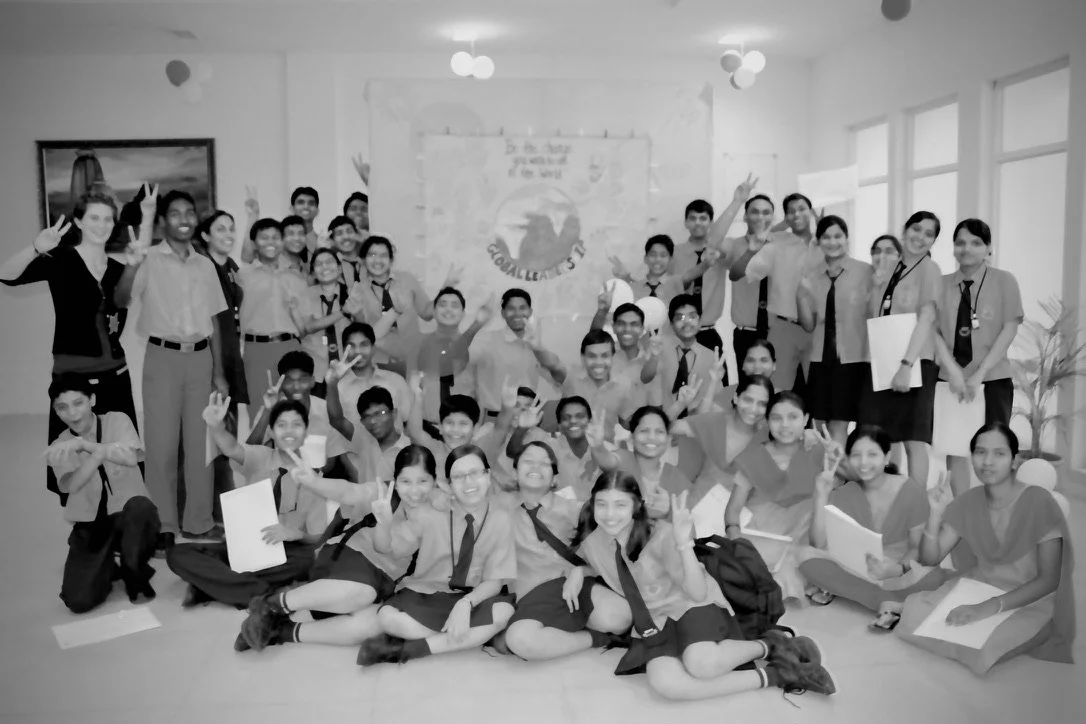
I don't even know where to start. I'm here in India, in Bhubaneswar, safe and sound (if not still jet lagged and completely overwhelmed.) The past five days have been a whirlwind. I'm not sure I can describe the immensity of it all here but I'll try to give the basics. There is a school call KIIT (Kalinga International Institute of Technology) that is an expensive boarding school for grades 1-12. The money made from this school as well as the KIT University funds another school called the Kalinga Institute of Social Sciences, KISS. KISS is a school for kids from tribal families and is an all-expense paid boarding school. The KIT schools and KISS were all an initiative started by one man who is also a tribal origin. The whole campus is amazing and unreal. We live in the dorm building of the KIIT school, on the same floor as the 6th grade girls in nice little rooms with a twin size bed, dresser, and desk and a communal bathroom down the hall that has hot water showers (when the water is running). After talking to all the powers that be and figuring out what we think is best, we decided we'll tag team teach the classes at both KISS and KIIT…
🌍
Lesson planning is still an intense process, but I think we've hit our groove of being able to engage with the students in a meaningful way, solution-oriented, and making our activities relevant to their lives (if only doing something they don't ever really get to do, like watch Wall-E. It fits into a discussion about environmental issues, right? Our students at KISS don't get to watch television AT ALL when they staying at school, let alone get to see movies.)
How do you design a curriculum for a group of students that a) don't attend on a regular basis for a multitude of reasons, b) are attending your class as an extra thing on top of all of their other classes, and c) is not boring and preachy and over-theoretical about "global" "issues"? Answer: spend a ton of time scouring the internet for fun, engaging lesson plans, spend a ton of time working with your fellow teacher in brainstorming approaches and little touches of nuance to keep it balanced between fun and didactic, and melt into a pile of goo when you see a student speak up for the first time or write a great answer to their homework question or spontaneously break into a meaningful discussion about microfinance. And, oh yeah, take your notions of perfection and sentences that start with "it could be better if..." and chuck them out the window…
🌍
Our KISS students have really come out of their shells, asking questions, speaking up more and engaging in our classroom activities with such fervor I want to take them all ‘home’ with me; or at least raise in inordinate amount of funds to ensure they can each attend college. Over the past couple of weeks, attendance was down because other classes were scheduled at the same time as our class. I don’t know how many times we have gone to speak with administration to solidify a schedule, calendar, verify holidays, days off, clear up conflicts with the time of our class, etc.
With our class at KiiT, we had to announce our class in no less than 5 assemblies and talk with the principal no less than 6 different times to solidify the class time and attendance for the next couple of weeks. The problem roots back to the beginning when we arrived at the school in January and our very presence was the first the administration at KiiT had even heard of our existence and intention. We’ve done the best we can with the time slot they have given us, one that asks the students to choose between the little free time they have and attending our class. A couple of students attend religiously. And it is through them that I keep motivation.
It’s hard not to get caught up in the ‘whys’, ‘what happeneds,’ and ‘what could have beens.’ It’s hard to have faith in that which you cannot see. It’s hard to break out of the Western mindset that only measurable outcomes have value. How would we ever be able to measure what we inspired in one, if not all, of our students? I think I am caught between lamenting the inefficiencies of the program and seeing that what little time we have spent has caused visible positive change in our students that I wish we could do more. A paradox of mind-boggling power.
I haven’t written much about the challenges (most likely as a defense mechanism) but I think it’s important to try to convey the yin and yang of a program like this. And to convey my own eternal struggle between accepting and cherishing what is, recognizing its long-term impact is in many ways unknowable but no less valuable, and my constant ambition to improve and maximize its effect.
We have worked hard to make our lessons relevant to our students, taking big concepts like ‘poverty’ and ‘social issues’ finding ways to encourage our students to problem-solve in a way that is translatable to the personal and local level. We were basically only given the ‘what’ before we came here and created the ‘how’ almost from scratch. This is no small feat.
I am extremely grateful for the opportunity to be here and to be able to see and experience a country and culture in a much deeper way than a tourist. Every coin has two sides; the knowledge and perspective I am personally gaining from being here along with the satisfaction from seeing some of the students throw themselves into an activity analyzing social issues, their cause, and possible solutions far outweighs the challenges and frustrations.
The same is true for walking down the street in Kolkata, or Delhi, or Bhubaneswar seeing how incredibly hard it can be for people to live and survive here, the cycle of poverty, lack of resources, and papers touting the latest government official accused of corruption. What do you do? It can all be too much sometimes. Saying nothing about the reality of a situation is not an option. And what to do is not always apparent. Watch, learn, observe, participate, breathe in compassion for yourself and others, take risks, take solace, cry, scream, speak up, speak out, laugh, live. What else can you do?
🌍
Things I have learned in India: It takes approximately 4 months to adjust to and learn the finer nuances of communicating with school administrations to accomplish what you want. 4 months to understand the chain of command, 4 months to perfect the balance of assertive and deferential, 4 months to figure out how to pull a star out of the chaos.
My colleague and I have kicked some proverbial a** in designing and now executing a group project with 20 students from the KiiT school and 21 students from KISS to conclude our Global Leadership course. For the entire week and half of next, all the students are working in 5 mixed groups of 8 students each to research an international city, analyze the economic, environmental, social, and health issues in that city and come up with their own initiatives to propose as solutions.
We emailed all the right people with all the right information. We devised a divide and conquer system that took care of all logistics from transporting students from one school to another to getting the supplies we need to planning each day's intensive activities and lesson striking the perfectionist (as we are both slightly prone to being) balance between fun and didactic. The results were amazing to watch. There was some apprehension about how the students might interact. KiiT is a slightly pretentious boarding school with very privileged students. KISS is a school for kids from tribal areas and tend to be much shyer and reserved.
Day 1: Getting to know each other. The first activity we had them do in their groups was think of a word that describes them by using the first letter of their name and go around in a circle and introduce themselves and having to memorize each other's names. Some students took it so seriously it took them more than 10 minutes to come up with their perfect descriptive word. The second activity was that each group had to build two shuttles/encasements out of the materials we gave them that would protect a raw egg from being dropped from 10 meters high. The trick was they had to trade with other groups to get a variety of supplies to complete the task. They all were engaged. They all were working hard. They all watched with the utmost apprehension as their creations fell from 30 meters.
It's as if the last four months was our training and preparation for this project. We've perfected our art of lesson planning and timing. We can engage 40+ students in one class and figure out ways to make big issues relevant and problem-solving empowering. There are a million road bumps and potholes this project could go through in the next ten days. Today was so fantastic that I'm certain we will be able to handle almost any of them.
🌍
Day 2: Each team came up with a team name and picked their city from a bag. (Tokyo, Los Angeles, Nairobi, Beirut, or Buenos Aires.) I spent something like 4 hours total printing out wikipedia information and fact sheets on each city, drawing the outline of each country on its own poster, cutting the posters into puzzle pieces to make the activity a little more challenging and engaging, coming up with 20 questions the students should research about their city (history, geography, culture, statistics, etc), and cutting the questions into stacks to distribute to pairs within each team to research.
Lessons learned:
When asking for a computer lab with 12 working computers, make sure to specify that all of those computers should also be connected to internet.
When asking for access to the library, make sure to specify that the librarian should be there to help the students find books.
When planning a lesson that involves 40 students, make sure the directions are simplified to accommodate for such curveballs as having no internet for half the class time and no librarian.
If you're stressed out, your students will be too. Channel that theatre degree you have and act calm, cool, and collected.
Remember that any time you give students markers and colored pencils and a reason to be creative, they will get completely absorbed in the task and forget any previous research/question answering-related frustrations.
When working with a group of students that are used to always having whatever they want and a group of students grateful for getting what they need, there needs to be a stronger yet subtle way to encourage teamwork. Solution: make teamwork and inter-school interaction a part of the points system. Teams who exhibit this well will get points for it.
When your lesson plan seemingly falls apart in front of your eyes, your students invariably will bounce back and surprise you in ways you could not have imagined in their level of engagement. Example: the biggest smiles on the faces of two KiiT students who could not be happier than having the 10 minutes waiting for the buses back to their school to interact freely with KISS students.
Always have every phone number you can think of of anyone who does anything with both schools. That way when your buses don't show up to pick up your students after you're already a half an hour over class time, you can minimize wait time and student anxiety for being late to their next class.
40 students + 20 questions + 5 posters with country outlines + 12 computers + 5 packets of information + 5 packs of markers/glue sticks/tape/scissors/extra poster paper + a vice-principal + the physics teacher + the computer lab teacher + the charm and wit of my co-teacher + two bus drivers + and then some = one two hour class period. Bringing together two groups of students who normally would never interact with each other + researching cities to a level they never have before + empowering them with an outlet for creativity and problem-solving = priceless.
🌍
Day 3: Sentimental sucker punch to the gut: some of the students from KISS (school for kids from tribal areas) have NEVER done research on the internet. As evidenced by our experience yesterday, the internet capabilities at their school as well as integration of computers into their curriculum is extremely limited. Watching the KiiT students help them do key word searches and sift through information gave me goose bumps. Sriya and I joked that we didn't care if the students finished their questions or not, just seeing them interact and explore was enough. We laughed a bit, and then realized we were actually serious.
We didn't have to worry about them not finishing though; they all trudged through these difficult, intense questions with dedication. Some students were writing down diagrams of the causes of poverty in their notebooks. Others were scrutinizing the systemic causes of corruption. Some struggled with navigating google and key word searches. And their teammates naturally went to help them out.
🌍
Day 4: Today was relatively simple. No computers needed. No crazy tote bag of supplies. Just guiding students through activities to help them come up with solutions to the world's problems. What more do you need than a pen and a piece of paper?
Armed with just that, we asked the students to write the one issue they researched in their assigned key area (health, social, economic, or environment) yesterday in the center of their paper. As a group, they had to choose one solution of all the solutions in their group to expand on even more in detail. And let the debates begin.
Having students debate about huge issues and solutions is quite possibly the best way to engage them in thinking about their solutions critically, defending their decisions, and organizing their information. They LOVE to debate. Their whole body language changes. Their voices reach a new pitch and intensity. The downside to the activity is that it also highlights how the KiiT students are much more dominant, bold, and comfortable in their English language skills which clearly intimidates the KISS students and mutes their comfortability in speaking that we had built with them in our class with them.
My hero for the day is Mitra, one of the shyest, quietest KISS students. His team wanted him to be involved in speaking during their counterargument of the debate and asked him to share his experience in his tribal community as a part of their point. He stood in front of the class and completely froze. His nerves about speaking in front of everyone was compounded by the fact that he was incredibly self-conscious about his English. Some students tried to cheer him on, others squirmed in their seats with the uncomfortable situation. Luckily his teammate saved the day, asking me if I minded if he spoke in Oriya instead to which I replied of course not. And off Mitra went, telling his story, a good portion of it behind his hand that he kept forcing down to his side but would keep creeping up to cover his mouth out of sheer anxiety. But he got through it, said his point, everyone understood, and the relief on his face when he sat down was only surpassed by the simultaneous look of pride. My eyes had welled up (yep, another sentimental sucker punch).
🌍
Day 5: Today I had moments of feeling completely ill-equipped as a teacher with moments of feeling proud of how far we have taken our students.
Given that we are cramming about two year's worth of economic, social studies, and science curriculum with a leadership training twist into less than four months, and even more microcosmically into an 8 day project, I wish we had more time. On the other hand, the quality of work that some of our students are producing is impressive. We reviewed their answers to the research questions we gave them on Wednesday and some of them were broad (as you would expect for asking things like what are the causes of poverty and only giving them one day to work on it) but some of them drew diagrams of the many causes of poverty, citing such things as the interconnection between disease and discrimination. I'm pretty sure at the age of fifteen I would have struggled to explain the interconnection between disease and discrimination.
Every day we learn something new, a nuance in making directions clearer or a process easier, and it's hard not to get caught up in "if only I had known that sooner, our students could have [fill in the blank]" "if only we had more time" "if only ...." This experience has been a bit mind boggling when sometimes you feel like you have so much time to complete a task or go through a course unit and other times you feel like you're scrambling blind up a hill in the dark to reach enlightenment at the top while being chased by Hesitation, Expectation, and Perfection. And if I can take the analogy-making another step too far, it's like what a carnival ride would be if you combined a merry-go-round with a roller coaster....
🌍
Day 7: Our tribal community is full of absolute poverty which are known as below poverty line. Mainly there are a large number of people which have no basic needs in our community. I think the lack of education is a biggest cause to poverty so I help our community cooperative society by bring awareness among people. So I as well as possible help them. - Baikuntha
I want to just stop the social issue of child labor and give them the right education and then help them to show their own talents which they like to do. -Induja
A strong will can help us to do the things we wish to. The people who are great are not born great but they have the faith and courage to bring a difference. I hope I would try to bring up that hope in myself. - Mun Mun
When I will get job I will help my tribal people to go to high standard [high school]. I will help the tribal children to study. How they will get education, how they will develop, I will help them. -Sita
These are just a few examples of what our students wrote for our final activity in class. After the last two days of the five teams working hard on their posters and final presentation, we ended our global leadership course with a couple of inspirational videos to focus them on themselves personally and what they each believe they will do to make a difference in the world.
“The power of one is the power to do something. Anything.” What will you do? We asked the students to trace one of their hands and write inside their hand their pledge as a leader.
It has been a challenging, but relatively smooth past couple of days. Ensuring that each group is working together, each sub-committee working out their solutions in a comprehensive (as much as relatively possible) manner, finding classroom space for them to spread out and practice their presentations, helping them with computer download glitches, and basic overall orchestration of our 43 students. I have a refreshed and even deeper respect for teachers.
🌍
Our students are amazing. The rose above and beyond the occasion, working hard to make their presentations as perfect as possible. Watching their energy, dedication, and enthusiasm this past week and during their final celebration event was humbling enough but a conversation with two students after the event was over was even more humbling.
They told us how they were working at home until 1am on their presentation. How their teammates at KISS school called them in the middle of the night from a clandestine cell phone and asked them what else they could do to help with their presentation. How at least one student from KISS school stayed up until 3am memorizing and practicing his part of their presentation. How several students practiced over and over again to perfect their English and pronunciation. How several KiiT students ditched most, if not all, of their classes that day to finish their power point presentations and scripts. There are some things you create that become so much bigger than you imagined that it takes on its own momentous, transformative energy in which you are no longer an instigating part but a witness to its power.
We spent hours going through student artwork/projects/posters and hanging them up on display boards for the event. We handed out dozens of invitations to teachers and administrators to come watch. We coordinated computers and pen drives and equipment to line up their videos and power points. My colleague, as the principal coordinator of the event, wrangled who knows how many different key players into arranging refreshments for after the event. We solicited the help of three fabulous teachers to judge our students' presentations. It all went off with out a hitch. We even had everything coordinated and ready to go AHEAD of schedule. Each group gave its presentation and while the scores were tallied we handed out their certificates of completion where they clapped loudly for each other and smiled with pride. After refreshments, a crazy scramble of photo shoots with the different teams and group photos, hugs, high fives, swapping of contact information, the inevitable time came where the KISS students had to go back to their campus and the KiiT students had to go back to class. Watching the KISS students walk to their buses was as intense as I expected. Someone must have been cutting strong onions nearby.
We also printed pictures for all of the students, one of the entire group and another one with that particular student in it from a different time of the course. We spent roughly three hours writing notes to each of the students on the back of their pictures. Most, if not all, of the students at KISS do not have a printed picture of themselves, much less a long note from two teachers/cheerleaders. We are really really going to miss them.
